
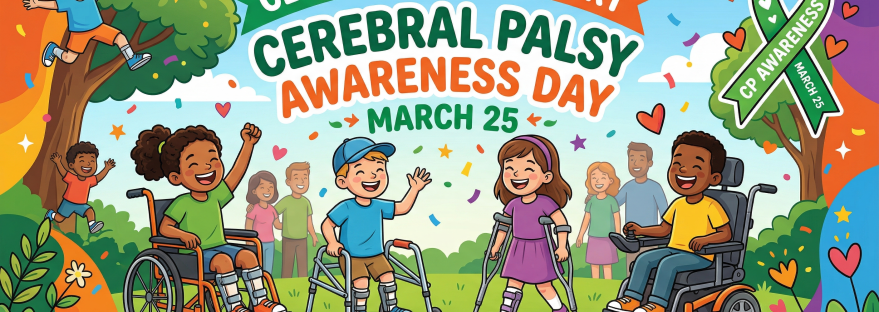
March is Cerebral Palsy Awareness Month. The color is green. And if you’re someone who actually lives with CP — or loves someone who does — you already know what we don’t need more of.
We don’t need more pity. We don’t need more cure-focused charity campaigns that treat our bodies like problems to be solved. We don’t need “inspirational” videos of disabled people doing ordinary things to remind non-disabled people that we exist.
What we need is a world that was actually designed with us in mind.
Here’s what that looks like in practice:
- Real access: Physical environments that are genuinely accessible — not technically ADA compliant, while still being functionally impossible to navigate.
- Healthcare that respects us: Medical systems that listen to people with CP rather than speaking over them or assuming incompetence.
- Communication access: Communication tools, AAC devices, and support for people with CP who communicate differently — without gatekeeping or making us prove we’re “worthy” of those tools.
- Employment and education: Workplaces, schools, and community spaces where people with CP are hired, enrolled, included, and promoted — not just welcomed as token exceptions.
Cerebral palsy is the most common motor disability in childhood. It affects people across a huge range of bodies, communication styles, mobility levels, and support needs. Some people with CP use wheelchairs. Some walk. Some use AAC to communicate. Some speak. Some live independently. Some need extensive daily support. There is no single CP experience.
That diversity is exactly why “awareness” campaigns that flatten CP into one image — usually a child in a wheelchair with a “fight” narrative — miss the point entirely.
This month, here’s what you can actually do:
- Follow, boost, and pay people with CP who are advocates, artists, educators, writers, and leaders — not just “awareness” spokespeople.
- If you run an organization, ask: Do we have accessible bathrooms, entrances, seating, and technology? Could someone with a physical disability actually work here full-time?
- Push back on cure-focused fundraising that doesn’t include people with CP in leadership and decision-making.
- Listen to and amplify the voices of disabled people — especially those who are also multiply marginalized by race, class, gender, or immigration status.
If you have CP: This month is yours. You don’t have to perform resilience or gratitude. You get to take up space exactly as you are.
Cerebral palsy awareness without access, representation, and power is just decoration. Let’s do better than that.
Call to action: Share this with someone who makes decisions about hiring, events, or built spaces. Ask them: Is your space actually usable by someone with CP? Then push for a real answer.
